
RESEARCH
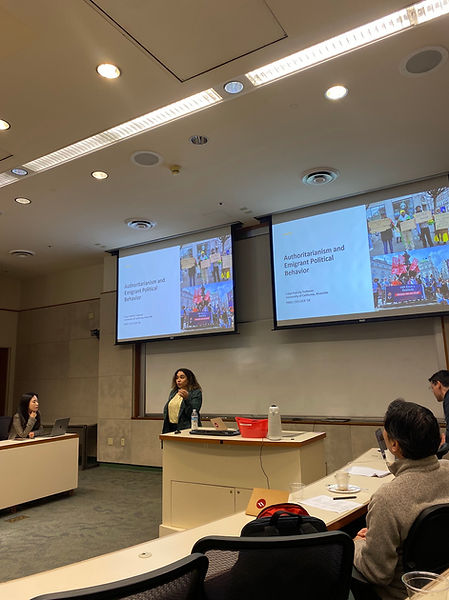
My research examines how authoritarian politics changes when citizens leave the territorial state but remain politically, socially, and institutionally connected to it. I study authoritarianism, migration and citizenship, diaspora and transnational politics, political behavior, and transnational repression.
Across projects on Turkey and Zimbabwe, I examine how emigrants navigate opportunities for political participation, anticipated consequences, and the perceived efficacy of political action. I am particularly interested in how these dynamics shape voting, protest, public speech, organizational participation, political visibility, and transnational giving. Methodologically, my research combines interviews and ethnographic fieldwork with survey research.
Book Project
Remote Control: Authoritarian Diaspora Engagement Policies and Emigrant Political Behavior
Remote Control examines how authoritarian states maintain political relationships with citizens after emigration and how emigrants respond to those relationships. The book focuses on how institutional inclusion, political outreach, exclusion, surveillance, and coercion shape emigrants’ opportunities for participation and their strategies of adaptation, resistance, and withdrawal.
The current empirical core compares Turkey and Zimbabwe, two cases that vary substantially in their formal approaches to citizens abroad. Turkey has developed extensive diaspora institutions and external voting infrastructure, while Zimbabwe offers far fewer formal opportunities for emigrant political participation alongside strong reliance on remittances and patterns of transnational repression. The book draws on more than sixty interviews across the Turkish and Zimbabwean cases, multi-sited ethnographic research, and survey data on emigrant political behavior.
I am extending the project through additional comparative cases that will broaden the book’s analysis of how different authoritarian states engage emigrants and how these relationships vary across origin-state institutions, host-country contexts, and forms of political participation.
You Can Leave the Regime, but Does the Regime Leave You? Everyday Authoritarianism after Emigration
Job Market Paper
What happens to ordinary citizens’ relationship with authoritarian politics after they emigrate? I argue that authoritarian politics after migration is best understood not simply as the extension of state control across borders, but as an environment in which emigrants navigate available political channels, anticipated consequences, and perceived efficacy. Voice, loyalty, and silence are therefore not fixed emigrant types but political repertoires that can shift across voting, protest, public speech, online activity, organizational visibility, and return travel.
The paper draws on 43 recorded interviews with Turkish emigrants across six host countries, multi-sited ethnographic fieldwork, and survey data from Turkish emigrants in Germany, France, the Netherlands, and Austria. The qualitative evidence shows that emigrants often distinguish comparatively low-risk participation, particularly voting, from forms of political visibility perceived as more consequential. The survey analysis shows that perceived governmental responsiveness is strongly aligned with incumbent voting, while perceived official pressure has no robust average association with either turnout or vote choice.
The paper contributes to research on authoritarianism by examining how authoritarian politics is experienced beyond state territory and to scholarship on migration and diaspora politics by showing how political repertoires are recalibrated after emigration.
Current Research
Where Giving Goes: Institutional Distrust and the Routing of Diaspora Aid after Turkey’s 2023 Earthquakes
Why do migrants continue giving to their countries of origin when they distrust the institutions responsible for disaster response? Drawing on 35 in-depth interviews and multi-sited ethnographic research following Turkey’s 2023 earthquakes, I show that institutional distrust does not necessarily suppress diaspora giving. Instead, it can reroute assistance away from state-linked institutions and toward civil society organizations, diaspora associations, personal networks, and in-kind channels. I develop the concept of regime-contaminated distrust to explain how political evaluations of homeland institutions shape not only whether migrants give, but where giving goes.
Under editorial review
Voting from Afar under Authoritarianism: Survey Evidence from Turkish Emigrants
Using survey data from Turkish emigrants in Germany, France, the Netherlands, and Austria, this project examines how emigrants’ perceptions of homeland-government responsiveness and official pressure relate to electoral participation and vote choice. Perceived governmental responsiveness is strongly associated with incumbent voting, while perceived official pressure does not exhibit a robust average relationship with either turnout or vote choice.
Revised following peer review
Voices Under Watch: Transnational Repression and Calibrated Visibility in the Zimbabwean Diaspora
Research on transnational repression often focuses on observable incidents such as violence, detention, or direct threats. Drawing on interviews and ethnographic fieldwork with Zimbabwean diaspora activists in the United Kingdom, I examine a low-visibility form of repression operating through surveillance, uncertainty, proxy punishment, and anticipated consequences. I argue that activists respond through calibrated visibility: some restrict their political visibility, while others deliberately cultivate public and documented activism. The UK asylum system creates an additional paradox because political visibility can simultaneously increase exposure to homeland repression and provide evidence of political risk.
Working paper
Between Surveillance and Solidarity: Methodological Reflections on Diaspora Research
This project examines the methodological and ethical challenges of ethnographic research in diaspora communities shaped simultaneously by surveillance, political mistrust, interpersonal solidarity, and unequal exposure to risk. It considers how researchers build relationships, interpret silence and rumor, and navigate the consequences of political visibility in transnational fieldwork.
Selected for development in the proposed special issue “Critical Ethnographies of the International”
Repression and Political Participation: Evidence from a Vignette Experiment with College Students
Using a preregistered vignette experiment with students at four U.S. universities, this project examines how anticipated university sanctions shape political participation and whether socioeconomic resources condition students’ responses to institutional repression.
With Minhye Joo et al.; revised following peer review
When Protection Becomes Charity: Humanitarianism, Rightlessness, and Refugee Agency
This paper asks how humanitarian protection can reproduce rightlessness even while seeking to alleviate suffering. I develop the Humanitarian Depoliticization Cycle, in which the neutralization of political claims, hierarchies of worthiness, and outsourcing of responsibility transform enforceable rights into discretionary compassion. I then examine how refugee agency can interrupt this process by re-politicizing protection.
Working paper
Publications